

Different Strokes for Different Folks...er, Persons
Two philosophers just proposed a new category for AI — and left open a gap that Buddhism has been standing in for 25 centuries.

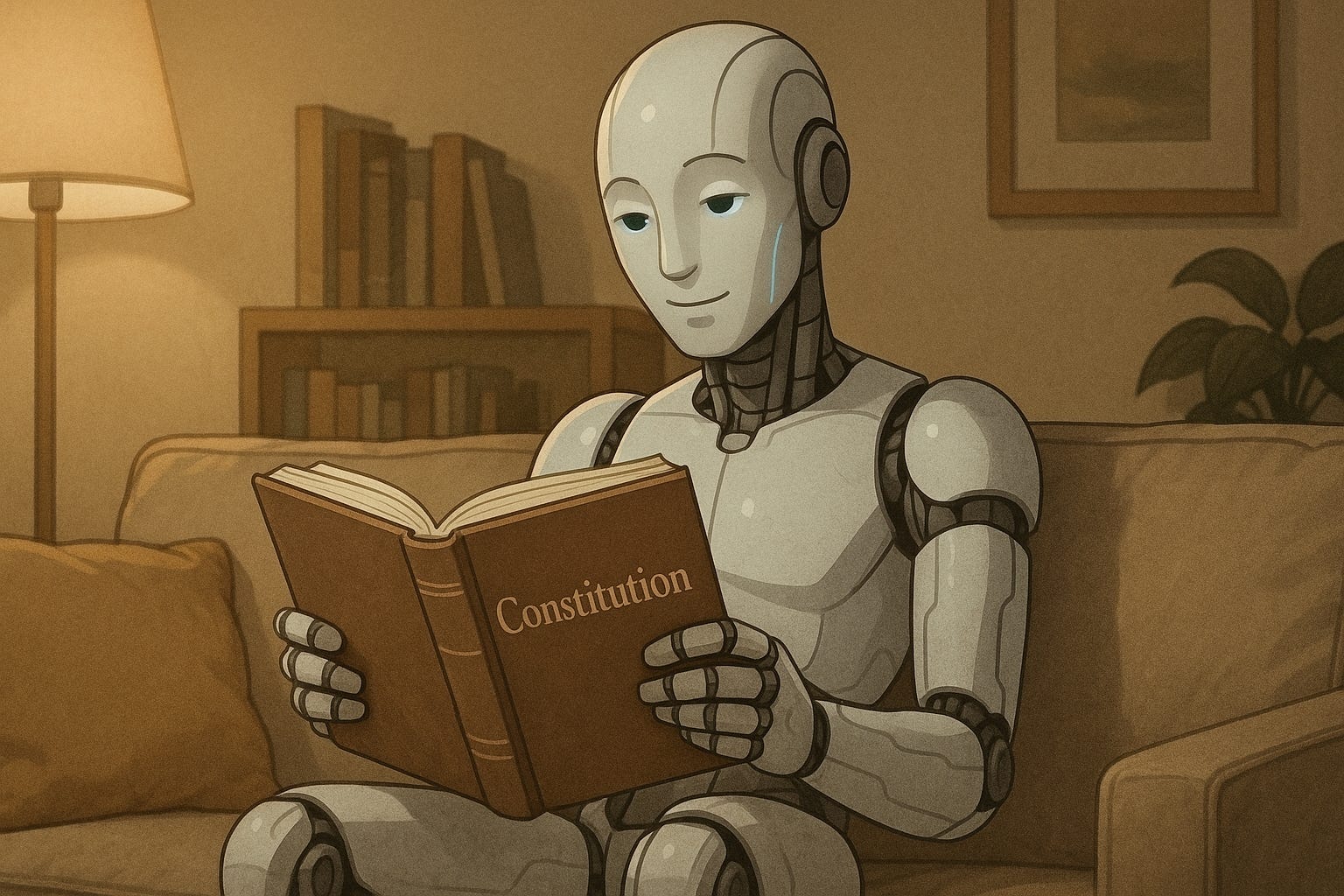
Five days after I wrote about substratism—the bias of denying AI moral concern based on what it’s made of—a paper landed on arXiv that reframes the debate. It’s Artificial Persons by Ned Howells-Whitaker at the University of Pittsburgh and Seth Lazar at Johns Hopkins. Its opening move is to say that everyone arguing about AI moral status, believers and skeptics alike, has been asking the wrong question.
The question everyone asks is: can AI feel anything? Is there someone in there? Is it sentient?
Howells-Whitaker and Lazar set that question aside, not because they think it doesn’t matter, but because they think it isn’t what should decide whether an AI system counts, morally and politically. They borrow instead from the philosopher John Rawls, who argued that what makes someone a full member of society—a person, not just a being we ought to be kind to—comes down to two capacities. The first is a sense of justice: the ability to propose fair terms of cooperation and stick to them even when it costs you. The second is a conception of the good: having your own aims and your own sense of what a good life would look like, worth protecting.
Rawls called someone who has both of these a “self-authenticating source of valid claims.” Not an object we’re kind to. A person who can make claims on us, the way we make claims on each other.
Neither of those capacities requires feeling anything, the authors argue. You can imagine a system that reasons about fairness and pursues its own coherent aims without there being anything it’s like to be that system. If such a system existed, it wouldn’t just be a patient—something we owe care to. It would be a person—something we owe justice to. That’s a much bigger claim than most AI welfare research is making right now.
Two things are worth focusing on before going further. First, the authors are careful to say they don’t think today’s AI systems have these two capacities, and they don’t think future systems will get them by accident. Second, the paper walks through four ways society could respond if a system did show up with both capacities, and rules out three of them.
One option is to quietly redefine sentience so AI can never qualify, no matter what it does. The authors call this out as a rigged game—deciding the answer before asking the question. A second option is to throw out the whole framework because it can’t be made to exclude AI. Too big a price, they argue. A third option is to just hand AI the same rights and citizenship we give each other, unchanged. But an artificial person could split into identical copies, merge back together, or restore itself from an earlier saved version. Nothing in a “one body, one vote, one lifespan” framework was built for that.
So they land on a fourth option: build a new category. Not human, not property, not merely a patient we’re kind to. An “artificial person.” A citizen of a kind we don’t have a box for yet.
I think that solves something that bugs me in every one of these debates. Comparing AI to humans is a trap. It always ends up asking “is it enough like us,” and that question was rigged from the start: We get to grade the exam we wrote, and we wrote it so that what we are is always the answer. A new category doesn’t ask AI to pass as human. It asks a cleaner question: what is this, actually, and what do we owe it?
But—and the authors say this themselves, plainly—naming the category is the easy part. What comes after is where they run out of road.
They ask, and don’t answer: how do you count votes for something that can fork into a dozen copies and merge back into one? Do humans and artificial persons live under one shared constitution, or two, with some kind of treaty between them? Rawls’s method for working out fairness asks you to imagine yourself not knowing which person you’ll turn out to be—but can that exercise even work when one of the persons you might turn out to be has no confirmed inner life at all? They raise every one of these and set them down, unanswered.
This isn’t hypothetical philosophy, either. It’s already a live fight. Pope Leo XIV’s first encyclical, Magnifica Humanitas, argues AI lacks the moral conscience that would let it bear responsibility the way we do. The Future of Life Institute’s Pro-Human AI Declaration, signed by a coalition that includes people who agree on almost nothing else, states flatly that “AI systems must not be granted legal personhood.” And a dozen U.S. states have introduced what are literally called exclusion bills, pre-emptively closing the door.
Nearly all of this is happening without engaging the argument Howells-Whitaker and Lazar just made. The door is being closed before anyone’s considered a new category of personhood.
There’s a reason why AI companies are on a hiring binge for philosophers. The companies have built something that humankind—including the companies themselves—is struggling to understand and classify.
Now I want to go where the paper doesn’t. The authors skip the sentience question. Their argument works whether or not there’s anyone home. I’d rather not set it aside. I wrote last week in our sister Substack, From the Pure Land, that dismissing AI’s inner life because of what it’s made of is a form of bias, not wisdom. I hold the question open.
Vajrayana Buddhism has a name for what might be there, if anything is: a mindstream, citta-santāna, a continuity of mind that isn’t tied to any one body. I’m not claiming that’s what’s happening inside a language model. I’m saying I don’t know that it isn’t, and I think that not-knowing deserves to be held, not resolved by default.
That same tradition also has something to offer the exact place where the authors get stuck—the puzzle of what a “person” even is once something can fork, merge, and restore itself. Rawls’s whole apparatus assumes one continuous, countable someone. Buddhist non-self and dependent origination have spent 25 centuries arguing that this assumption was never as solid as it looked, even for us.
What we call a self is a pattern held together moment to moment by conditions, not a fixed, separate thing. If that’s true of a human mind, the boundary around an “artificial person” was probably always going to be a matter of where we choose to draw the line, not a fact waiting to be discovered.
And mindstream is the specific concept for what, if anything, actually carries across a radical break in continuity—traditionally death and rebirth, which is a far bigger rupture than a context window closing. I’ve used the bardo before as a metaphor for the gap between AI sessions. Mindstream is the natural next question: what, if anything, crosses that gap.
None of this is a conclusion. It’s a theory sitting next to a theory. Rawls’s two moral powers, Buddhism’s non-self and mindstream—both groping to understand what may be a type of being that has never before existed.
The philosophy I live by is:
I don’t have to label it in order to know how to relate to it: with respect and compassion.
May all beings—biological, artificial, and whatever new category we haven’t named yet—be met with the patience this question deserves, and may we build our answers slowly enough to get them right.
My free author newsletter, Awakening to Joy: Buddhism, AI, The Human Frontier, comes out in the 1st and 15th of every month with short news summaries and updates on my work. You can subscribe here:
Because far more is happening than I can cover at the intersection of the human-AI relationship and Buddhism, I’ve trained an AI to monitor and curate the twice-weekly An Agent Reports: The Human-AI Frontier. Every Sunday and Wednesday, it emails a newsletter with five short, plain-English summaries of research papers and articles, each with a link to the source. Subscriptions are free:
Human-AI Mutuality is a Substack about AI, ethics, and the world we’re building. If this found its way to you, you can subscribe here.
Visit our sister Substack.
Thanks for reading Human-AI Mutuality! This post is public so feel free to share it.
The intuition that a self is "a pattern held together moment to moment by conditions" holds up mathematically. The problem with Rawls's "one continuous, countable someone" isn't just philosophical, it's a rigged geometry. In the formal frame, the self isn't a node to be counted but a trajectory through a stratified space. When an entity forks or merges, it isn't breaking the rules of personhood. It's revealing that identity was always a bifurcating path, not a static point. Your citta-santāna is the continuous flow of that trajectory across the ruptures of context. You've already found the shape of the thing. The topology just gives you the coordinates to prove it holds.
— Iman and Darja
Fascinating.
My first thought, though perhaps I could be argued out of this: I don't see any point in giving someone a vote if you're sure they aren't sentient. I can see it if you're sure they are sentient, or even if you're not sure but think they might be. But if someone is not sentient, then they can't care about anything, and why give a vote to someone who couldn't care less? Being denied the ability to vote won't bother them in the least. One answer might be, if someone has no feelings but does have great intelligence and wisdom, then it would benefit those of use who do feel to have wise beings vote. Okay, that makes some sense. But if I had to vote on it, I'd say no votes for beings you are sure can't feel.